
Lucrative Digital Marketing Skills to Learn for Beginners
The internet makes digital marketing skills easy to learn, but making good money from them is where most people get stuck.
The problem often lies in how you position your value, not just how well you know the skill. You must understand how to talk about what you do, who it benefits, and the results it brings.
When Chidinma Ofoegbu started her career in 2020, she just wanted to write. She took on essay contests, volunteered, and started a blog where she wrote about her personal experiences and shared them on social media.
Her consistency brought visibility, which led to her first paying client, Business Yield. It came through a referral, and they offered her ₦700 per article. Small as it was, that opportunity confirmed that her writing was worth something to someone. Two years later, she was charging in dollars.
Freelance content writer Nathan Ojakomo moved even faster. Before he had any paid work, he pitched a CMO directly and landed a $200 client. Today he writes for brands like HubSpot and CoSchedule.
The path from learning a skill to earning from it looks different for everyone.
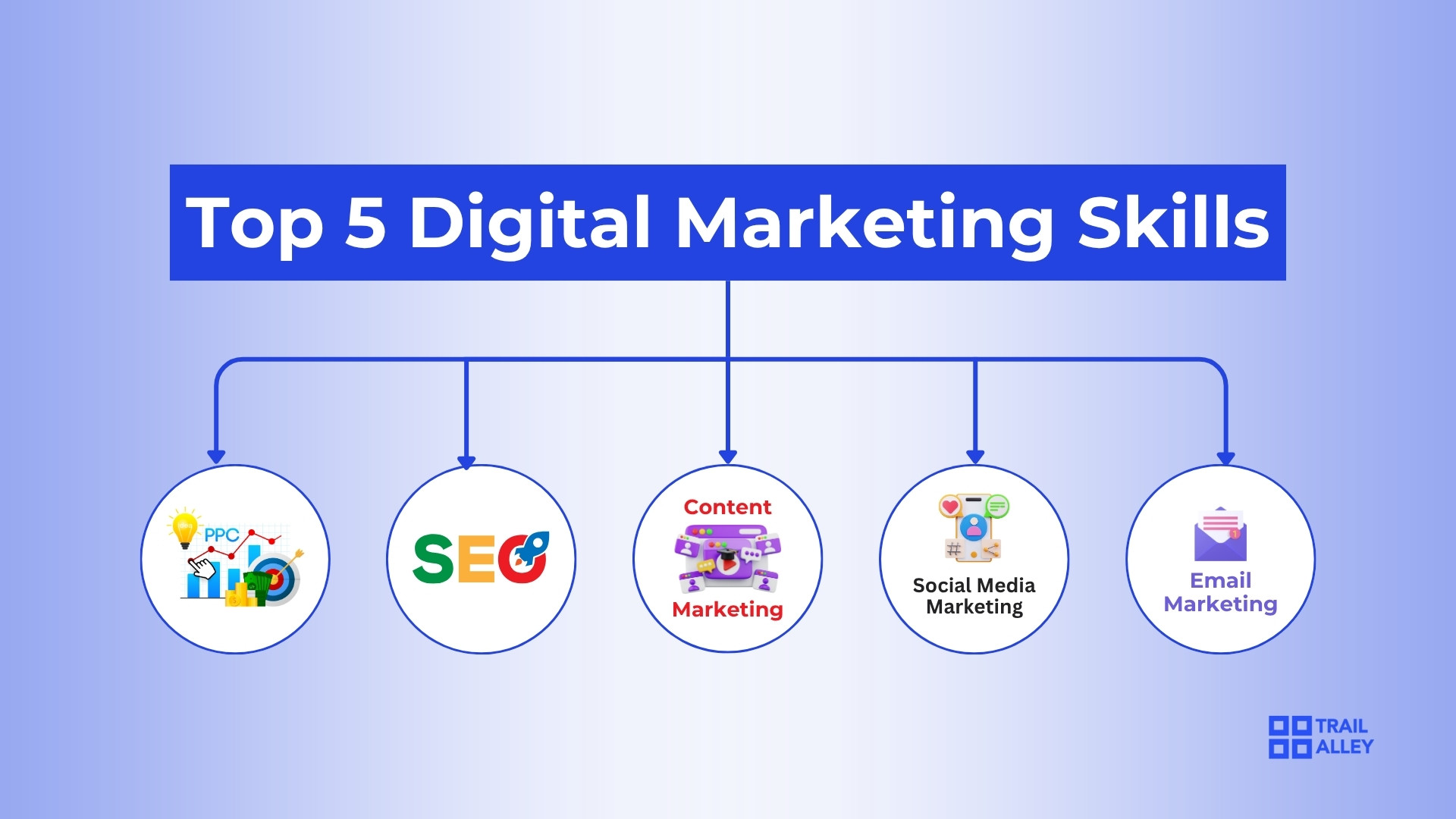
In this article, I’ll walk you through five of the most profitable digital marketing skills you can learn right now. For each one, you’ll get insights from practitioners who have built real careers doing this work, learn how long it realistically takes to start earning, the first steps to take as a beginner, and how to turn the skill into real income.
Inside This Article
The Most Lucrative Digital Marketing Skills to Learn in Nigeria
| DIGITAL MARKETING SKILL | TIME TO GET JOB READY | COURSES TO TAKE |
|---|---|---|
| Paid Advertising (PPC) | 3-4 months | Google Ads for Beginners |
| SEO | 6-12 Months | SEO Content Writing Masterclass and Fundamentals of Content Marketing |
| Content Marketing | 2-3 Months | Fundamentals of Content Marketing |
| Social Media Marketing | 3-4 months | Beginners Guide to Social Media Management |
| Email Marketing | 2-3 months | Email Marketing |
1. Pay-Per-Click (PPC) Advertising
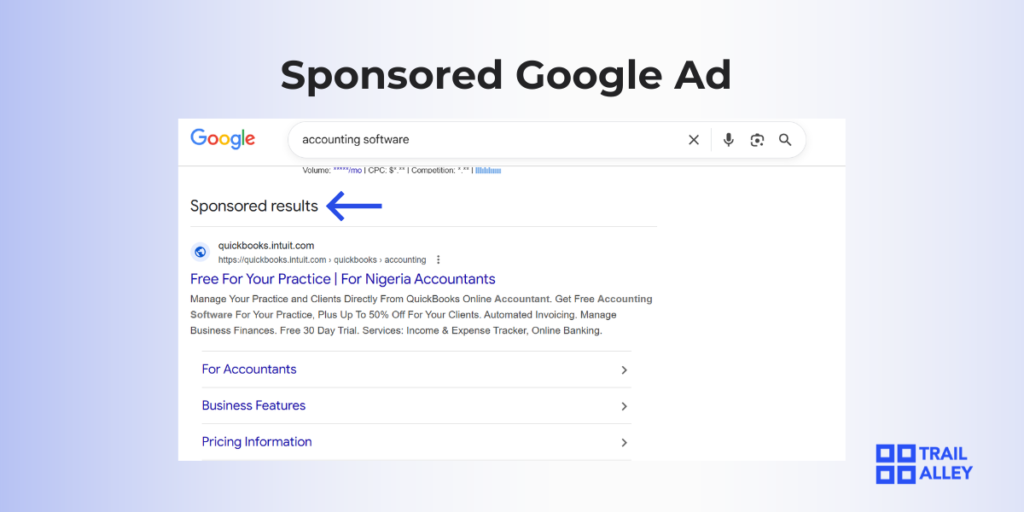
Every time you search for something on Google and see results marked ‘Sponsored’ at the top, that is a pay-per-click ad in action. It means a business paid to show up there, and they only get charged when you click on it.
As PPC Specialist Oluwole Adeosun puts it, “Businesses are fundamentally set up to make money, and if you can help them achieve that goal, you will be valuable.”
Your role as a PPC Specialist is to help the right audience see the ad and turn clicks into sales, leads, or sign-ups. More importantly, you need to prove that the ad spend is helping the business make money.
What You Need to Learn End-to-End As A PPC Specialist
PPC is a combination of skills that work together. Here is what you need to learn to function as a PPC specialist.
i. Start with Meta Ads, then Move to Google Ads
Meta Ads are the ads you see on Facebook and Instagram. They show up based on your interests, age, and behaviour. Google Ads show up when someone is actively searching for something. Bukayo Ewuoso, a PPC specialist, recommends starting with Meta.
He says that “Meta Ads gives you a foundation for multiple ad platforms.” In contrast, he notes that “Google needs much more expertise, is harder, and is more expensive.” You can take the Meta Blueprint course. It covers basics and advanced campaign strategies. Once that foundation is in place, moving to Google Ads becomes a natural next step.
ii. Learn the Basics of Analytics and Measurement
Analytics is how you read and understand the results your campaigns produce. Every time someone sees your ad, clicks it, or buys something after clicking, that information is recorded.
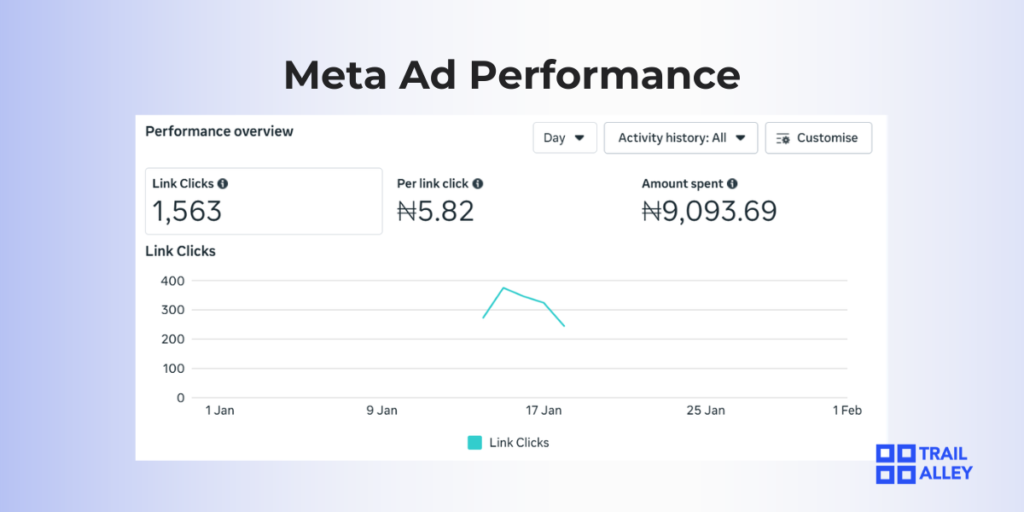
Meta Ads Manager gives you the overview of your ad’s performance. You can see how many people saw your ad, how many clicked, and if your tracking is set up correctly, what they did after landing on your page. For instance: Did they buy something? Fill a form? Or sign up?
Google Analytics works differently. It tracks people’s behaviour on your website. You can see how long visitors stayed, what they clicked, and whether they took action, regardless of where they came from.
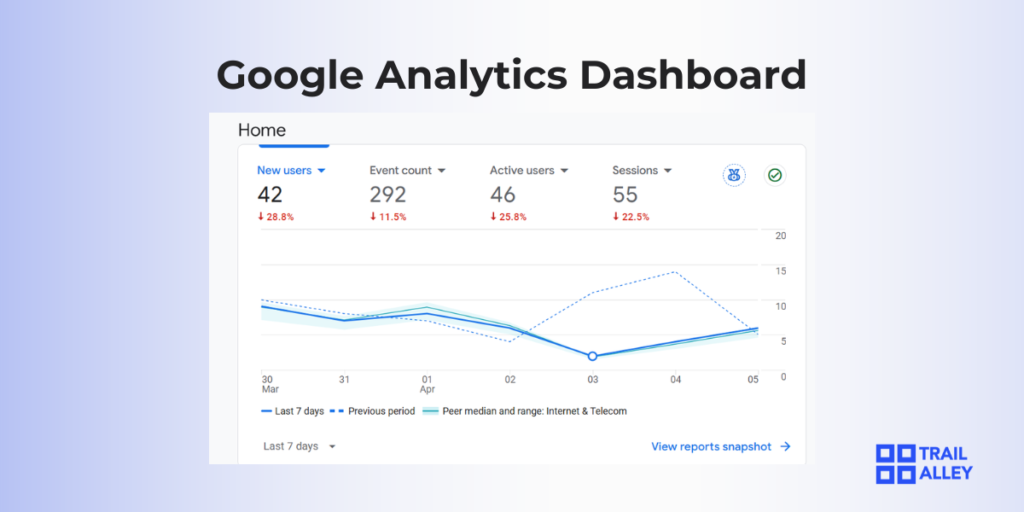
As a PPC specialist, you need to understand what that data is telling you. Oluwole explains, “your analytical skill is what will help you know what is working, what is not working, and when something is not working, what you should do about it. You need to be able to analyse your results and then optimise.” Without that ability, you might keep spending money on ads that are not working and have no idea on how to fix it.
iii. Understand Conversion Tracking and Google Tag Manager
Businesses run ads to drive people to take action. It could be buying a product, filling out a form, or signing up for a newsletter. Conversion tracking is how you understand if that action is happening.
You’d have to rely on Google Tag Manager to measure those conversions. As a junior PPC specialist, you may rely on a developer or a senior colleague to set up event tracking on Tag Manager. That is normal.
But over time, you need to develop at least a basic understanding of how it works and how to interpret the data it produces. As Oluwole explains, “you want to track a particular action on the website—even if you are not the one setting it up, you need to understand what it entails and be able to communicate it.” Without that understanding, you cannot tell whether your campaign is doing its job.
iv. Learn Ad Copywriting
An ad copy is the text inside your ad, including the headline, the description, and the call to action. In many cases, a copywriter will handle the writing. But as a PPC specialist, you need to understand what good copy looks like and whether it speaks to the people you are targeting.
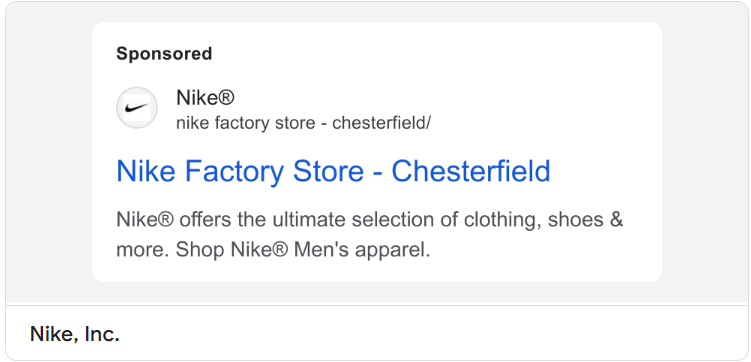
Every element of the ad should pull the reader in and make them want to know more. It should speak to what they care about, answer the questions they have, and remove any reason they might have not to click. The goal is to move someone from scrolling past to taking action.
v. Develop an Optimisation Rhythm
Optimisation means making small, regular changes to improve your campaign’s performance. It is something you do consistently to keep your campaigns moving in the right direction.
In Oluwole’s experience, “there are optimisations you do weekly, and some you do monthly or quarterly.” But checking in regularly is only part of it. Oluwole is clear that things will not always go as planned: “things are going to get worse at some point. Your job is to know what metrics to evaluate and how to diagnose the problem.” In practice, this means checking your click-through rates and costs weekly, reviewing your audience and budget monthly, and rethinking your overall strategy every quarter.
How Long Does It Take to a Become Job-Ready PPC Specialist?
I asked Bukayo, if three to four months is enough to learn PPC and become job-ready. In his words, “it is going to be tough to be job-ready in three to four months, but you can still be at least entry-level ready.”
Entry-level ready means you can assist on campaigns and handle basic tasks, but managing large budgets or complex strategies will come with more experience.
Here is a high level path to get there:
i. Test on a Real Business
Find a small business, a friend’s side project, or your own idea and run a real campaign with a small budget. That hands-on experience will turn your theoretical knowledge into a practical skill.
ii. Get an Internship
Look for an internship where you can work under experienced PPC specialists. This is where you learn the things no course can teach you, like how to handle real budgets, clients, and pressure to meet conversion goals.
iii. Understudy an Experienced PPC Specialist
Courses and test campaigns can only take you so far. At some point, learning directly from a senior PPC specialist is what accelerates your growth.
Oluwole describes how he handles this with juniors he brings onto side projects. “You are not directly responsible for the results, but you are there to learn the thought process behind achieving them.”
But that opportunity has to be earned. Before he invites anyone in, he needs to know they can handle the basics. “A live client campaign is not the place to train you from scratch,” he says. So before you approach a senior PPC specialist to learn under them, make sure you can already set up a basic ad on Meta or Google. That is the foundation they expect you to walk in with.
If you follow the steps listed above, by the end of 3 to 4 months, you will be able to show that you have set up campaigns, optimised campaigns, and seen how to improve them.
What to Display on Your PPC Portfolio as a Beginner
Your portfolio is proof that you can run campaigns that get results, and it comes in the form of numbers. But not every number tells the same story.
Reach and impressions are vanity metrics. They show how many people saw an ad,, but they do not show whether those people did anything useful after seeing it. A business does not care about that. They care how many bought, signed up, or took the action they were paying for.
Succinctly put, they care about ROI metrics which shows businesses whether the money they invested in an ad produced results. The numbers that belong in your portfolio are ROAS, CPA, and conversion rate. Those three tell the full story of a campaign’s impact.
Speaking on metrics a beginner’s PPC portfolio should highlight, Oluwole says:
You want to show that you 3X’d revenue, brought down cost of acquisition, improved return on ad spend, or increased the conversion rate. That is the statement your portfolio should make.
There is so much you can learn from running real campaigns, even before your first paying client. Interning at NGOs, startups or small businesses will give you a basic portfolio-worthy experience.
Mistakes Beginner PPC Specialists Make
By noting each mistakes, you can get ahead and produce worthy to note results every single time.
i. The Set-it-and-forget-it Mentality
Many beginners set up a campaign, let it run, and check back days later expecting good results. PPC does not work that way.
When a business hands you their ad budget, they are trusting you with money and expecting a return on it. Oluwole is clear about the pressure that comes with that: “Someone giving you 100K or 1M is expecting that money to do two times, three times, or four times.”
To achieve or exceed expectations, you need to frequently check what is performing, cut what is not, and make changes as you study the data.
ii. Copying a Strategy From One Industry Into Another
What works for an e-commerce brand will not automatically work for a service business.
Bukayo made this mistake early in his career. He had run successful e-commerce campaigns and assumed the same approach would work for a wellness business he later took on. It did not. In his words, “the product business is different from the services business. The audience behaves differently. The consumer journey is different. Everything that you need to write has to be different. I did not consider that.”
The bottom line is, you can’t approach ad campaign strategy from a one-size-fits-all approach.
iii. Ignoring What Happens After the Click
Your job as a PPC specialist does not end when someone clicks the ad. What happens after the click matters just as much as the ad itself. Oluwole speaks to this directly: “you need to know what happens after people click your ad. It could be that the form on the landing page is too long. It could be that your tracking is broken. That is why understanding the customer journey matters.”
The customer journey is the full path someone takes from clicking your ad to completing the action you want them to take. Every step of that path, from the landing page to the form to the page load speed, can either move them forward or make them leave.
The common thread across all three mistakes is that PPC rewards the specialists who stay hands-on. Set the ad up, watch it closely, understand the business behind it, and follow the full journey from click to conversion.
2. Search Engine Optimization (SEO)
If you want to buy a custom handbag and you live in Lagos, you’d probably search “custom made bags in Lagos” on Google.
Google then, pulls up websites with pages that answer exactly that query.
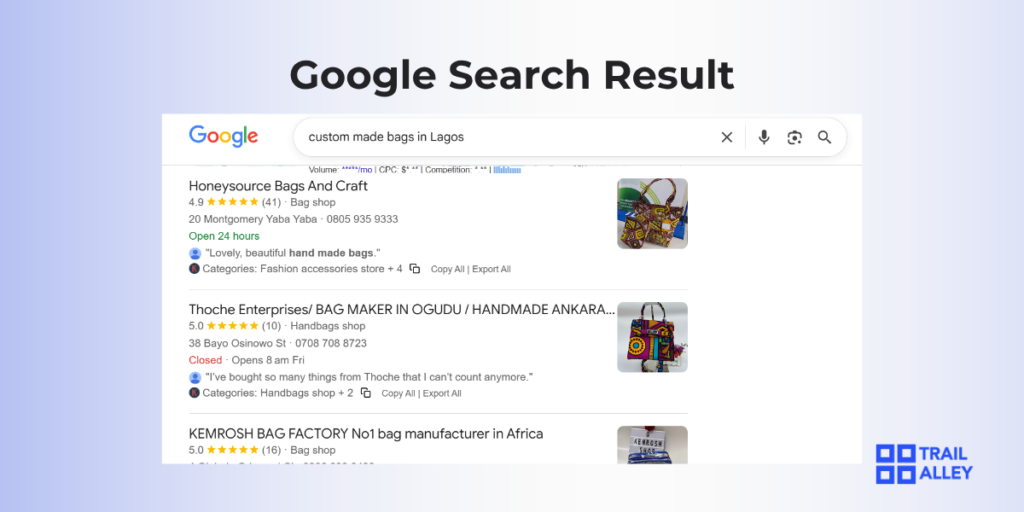
The businesses at the top of those results get the most clicks, the most visits, and the most customers. But those businesses didn’t end up at the top by accident. An SEO specialist helped them get there.
Search Engine Optimisation is a profitable digital marketing skill. That is because businesses want to rank on Google for free, without spending on ads. As an SEO specialist, your job is to help them get there by improving their website and content so that search engines like Google can rank them higher than their competitors.
With SEO, the work you put in today can keep bringing organic traffic for months or even years later. That compounding effect is what makes businesses willing to pay specialists who can help them rank and stay ranked on Google.
And it’s not just Google anymore. People now get answers from AI tools like ChatGPT, Perplexity, Gemini, etc. This brings us to two new important areas in SEO: GEO (Generative Engine Optimization) and LLM optimization. Both are focused on making sure a brand’s content shows up in AI-generated answers, not just traditional search results.
Where to Start as an SEO Specialist
SEO has three main areas. As a beginner, knowing the difference between them will help you decide where to focus first.
i. On-page SEO
On-page SEO is everything you do on the website itself. It mostly involves writing to answer the questions people are searching for on Google. For example, if someone types “why does my stomach hurt” into Google, they will find different websites that have written about that topic specifically to answer that question.
As an on-page SEO specialist or content writer, your job involves finding the right keywords people are searching for, writing content that answers those questions clearly, structuring pages so they are easy to read and follow, and adding meta titles and descriptions that help Google understand what your content is about and who it is for. This is where most beginners start because it is the most accessible area of SEO and does not require technical knowledge or access to the website’s backend.
ii. Off-page SEO
Off-page SEO is everything you do outside your website to gain the trust of search engines. But how does Google decide which websites to trust?
The main way is through backlinks. A backlink is when another website finds your content valuable and places your URL as a clickable link on their own page.
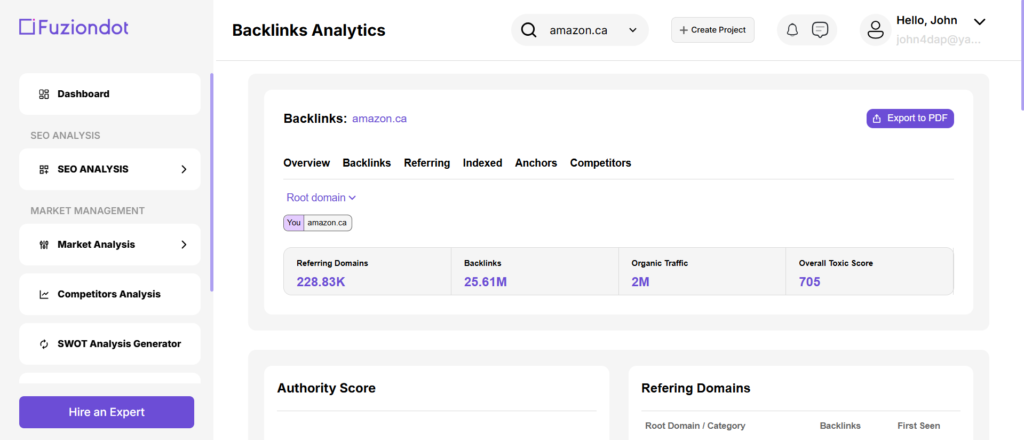
Think of a backlink like a recommendation. If a well-known brand like Amazon writes an article about the best hair clippers for men and includes a link to your client’s Amazon store or website, that is a backlink. Google sees that recommendation and takes it as a sign that your website is credible.
However, quality matters more than quantity here. One link from a highly reputable website is worth more than ten links from unknown or low-quality sites. This is why off-page SEO involves a lot of outreach—reaching out to reputable websites, getting your client’s content featured on established platforms, and finding opportunities for others to reference and link back to your client’s pages.
As a beginner, off-page SEO is best approached after you have a solid understanding of on-page SEO first.
iii. Technical SEO
Technical SEO is about making sure the website itself is set up in a way that search engines can find, read, and understand it properly.
Think about the custom bag business in Lagos again. Imagine their website takes ten seconds to load on a mobile phone, or some of their product pages are not showing up on Google at all. Those are technical SEO problems. The content might be well written and the backlinks might be strong, but if the website has technical issues, search engines will struggle to rank it no matter how good everything else is.
As a technical SEO specialist, your job involves fixing things like slow page load speeds, making sure the website works well on mobile, ensuring all pages are being picked up and indexed by Google, and fixing broken links or errors that stop search engines from crawling the site correctly. It requires access to the website’s backend and a deeper level of knowledge than on-page or off-page SEO, which is why I do not recommend it as a starting point for most beginners.
Start with on-page SEO, build your understanding of off-page SEO, and work toward technical SEO as your knowledge and confidence grows.
How Long Does it Take to Become a Job-ready SEO Specialist?
Longer than most people expect because SEO has no finish line. “For you to gain the best knowledge, you have to be in the industry, working every day,” says Faizat Hussein, an SEO strategist who is currently leaning into LLM and GEO optimization. In her view, three to six months is too short a window to call yourself a specialist.
What three to six months can give you is a strong learning foundation. Chidinma, who has mentored both content writers and SEO specialists, advises using that window to take structured courses, make mistakes, sharpen your drafts, and build solid proof of work.
The moment you understand the basics, start applying them—look for internships or volunteer opportunities where you can implement your learning.
However, you must note that SEO is one of those digital marketing skills where the work you put in today shows up weeks or even months later. As Faizat puts it: “SEO is like personal branding. The more effort and time you put into it, the more you are able to build bigger, better, and expand more.” But you do not need to wait months to know if the work is paying off. Early signs show up quickly. “There is no way you are not seeing improvement in your blog or your website in the first two weeks,” Faizat says.
Those early signals—ranking improvements, growing impressions, rising click-through rates—are exactly what you should be showing your clients. Many clients expect instant results, but part of your role is to set the right expectations from day one. Help them understand what progress should look like in the first two weeks, the first month, and the first three months so they can see the bigger picture and stay confident in the process.
To track those website improvements, free tools like Google Search Console and Google Analytics are essential. For deeper SEO analysis—such as keyword research, traffic insights, and keyword overviews—tools like Fuziondot, Ubersuggest, and SEMRush should be your go-to resources.
Finally, proof matters more than any certificate or course completion. Although Chidinma started writing professionally in 2020, she did not feel confident enough to raise her rates until 2022. It was not because it took that long to learn, but because that is when her results started speaking for themselves:
My confidence came from feedback and results. Clients responded well to my work. Editors trusted me with new projects. People came back with more tasks instead of disappearing after one project. I could see my writing doing what it was meant to do.
The lesson is not that it takes two years. Job-readiness in SEO often comes from the results you’re able to produce and how they impact businesses. So, that timeline is yours to set.
How to Build Your First SEO Portfolio With No Clients
Any business looking to hire an SEO specialist or content writer wants to see evidence that your work can rank, drive traffic, and deliver results. Without that evidence, even the best CV will not get you far.
The good news is that you do not need a paying client to build that evidence. Chidinma, with over 5 years of content marketing experience suggests four ways to start building a portfolio from scratch.
i. Start Your Own Blog
A personal blog is one of the most practical ways to practise on-page SEO and build proof of work at the same time. Over time, your blog turns into a live portfolio with real articles that attract traffic. It also shows potential clients and employers that you understand how SEO works in real life.
As a beginner, Chidinma started her blog after a friend helped her set up one. She wrote about her experiences there. Because of that, people started calling her a writer, even before she accepted the title. Chidinma believes her edge came from not waiting to feel like a professional writer.
Eventually, that blog became proof of her ability. As a beginner, your blog does not have to be perfect either. Choose a topic you’re familiar with. Then, find the keywords that people are searching for related to that topic. Finally, write content that targets those keywords to improve your ranking.
ii. Write Spec Samples for Your Dream Brands
A spec sample is a piece of content you write for a company without being asked or paid to do it. As Chidinma explains, “you do not need permission from a company to write for them. You can do it on your own, out of genuine interest, and if you decide to send it to them later, they might like what they see.”
So how do you decide which brand to write for? Chidinma suggests that you start by listing your dream companies.
For example, as a fintech content writer, if she wanted to write for Bamboo, the first thing she would do is study their website carefully. She would read their blog, pay close attention to their tone, and observe the kind of content their current writers produce. She would also look for gaps—topics or keywords they have not covered yet. From there, she would create a well-thought-out piece that fits their style and speaks directly to their audience.
Once you follow that process, you’ll end up with an article that becomes a strong and relevant part of your portfolio. Although it may be unpaid work, it can significantly improve your chances of landing a paying job or freelance gig.
iii. Guest Post on Publications Your Target Clients Read
Guest posting means writing articles for other websites and publications that accept contributions from writers who are not part of their internal staff. In other words, even if you do not work with a brand as an in-house writer, you can still contribute valuable content to their blog.
According to Chidinma, guest posting adds both variety and credibility to your body of work. In her words, “When people view your portfolio, they see different brands, different writing styles for different audiences, and different formats. That variety makes it easier for them to trust your range.”
This is exactly how Nathan, who has worked with brands like HubSpot and CoSchedule, built his portfolio. He explains, “Guest blogging was most helpful because the samples were published on reputable sites.”
Even with over five years of experience, Chidinma says she still actively looks for publications she admires that accept guest posts.
iv. Take on Personal Projects
Do not wait for a client to give you permission to create something. Chidinma is direct about this: “If you want to write reports, do not wait until a company hires you before you create one.”
She practises what she teaches. Knowing she wanted to write industry reports, she went ahead and created the State of Content Writing in Nigeria Report 2025 with the help of a few friends—without a paying gig or anyone’s permission. When she shared the first post announcing the report, it crossed 10,000 views on LinkedIn. Today, that project stands as one of the strongest pieces in her portfolio.
So, like Chidinma, give yourself permission to create and build for yourself. The work you start on your own may become one of the greatest investments in your career.
How to Get Started as an SEO Specialist
You have now seen why SEO made this list one of the most lucrative digital marketing skills to learn in Nigeria. What follows are three concrete steps to move from understanding it to actually building a career.
i. Take a Structured SEO Course
Before you touch a single keyword tool or open Google Search Console, you need a foundation. An SEO course gives you the mental map of how search engines work, what Google rewards, and how all the moving parts like content, links, and site structure.
Look for a course that covers keyword research, on-page SEO, and content strategy in one place. A good starting point is this SEO Content Writing Masterclass. Additionally, the Fundamental of Content Marketing course will help you understand how to create on-page SEO content strategy. Both courses are specifically for beginners who want to understand how SEO works. It is practical, and structured enough to give you direction without overwhelming you.
ii. Install Google Search Console on a Test Site
Google Search Console is a free tool that shows website owners which keywords are bringing people to their site, which pages are earning impressions, how many people are clicking through, and whether Google is even discovering those pages in the first place. It gives you direct insight into how your website is performing in Google Search.
As an SEO beginner, this is one of the most important free tools you will use. The only catch is that Search Console works best with a real, live website. You cannot meaningfully practise with it on a site that does not exist, which is why setting up a simple blog or test site early on is so important.
Once your site is live and connected to Search Console, data usually starts appearing within a few days to a few weeks, depending on how quickly Google crawls and indexes your pages.
If buying a domain feels like too big a commitment right now, free platforms like WordPress.com or Blogger allow you to get started at zero cost.
iii. Write Well Researched Blog Posts
Pick a topic related to a niche you understand. Use a free tool like Ubersuggest or apply for student access on Fuziondot to find a keyword people are actually searching for. Then write a post that directly answers what someone typing that phrase wants to know.
When you are done, submit the URL to Google Search Console and monitor it over the next few weeks. Watch what happens to your impressions, your average ranking position, and whether any clicks come through. That feedback loop—write, publish, measure, improve—is how SEO skills are actually built.
3. Content Marketing
Most beginners assume content marketing simply means writing blog posts. It doesn’t.
Content marketing is the strategic creation and distribution of valuable content that helps a specific audience solve problems, learn something useful, or make better decisions, while gradually building trust in a brand.
Instead of directly saying “buy this product,” content marketing starts with a strategy to give people something genuinely helpful first, whether it’s a blog post, video, email newsletter, case study, or social media post.
However, what makes content marketing truly effective is strategic thinking: deciding what to create, who it’s for, where it should be shared, and what action you want the audience to take after engaging with it.
Bright Afam, a content marketer who increased a SaaS client’s monthly revenue by over 20% in 90 days through blog content alone, puts it plainly:
Content strategy is the ability to think and craft the right ideas that will help you achieve business goals. It’s different from just writing blog posts because there you’re just guessing. You write based on instinct, not what the data tells you, not what drives business.
That mindset is what separates a content marketer from someone who just writes. Every piece of content they create has a clear job: to attract the right audience, educate, remove objections, build trust, and move readers closer to a buying decision.
Great Content Marketers Are Strategists
Where someone is in their buyer’s journey determines the type of content they need from you.
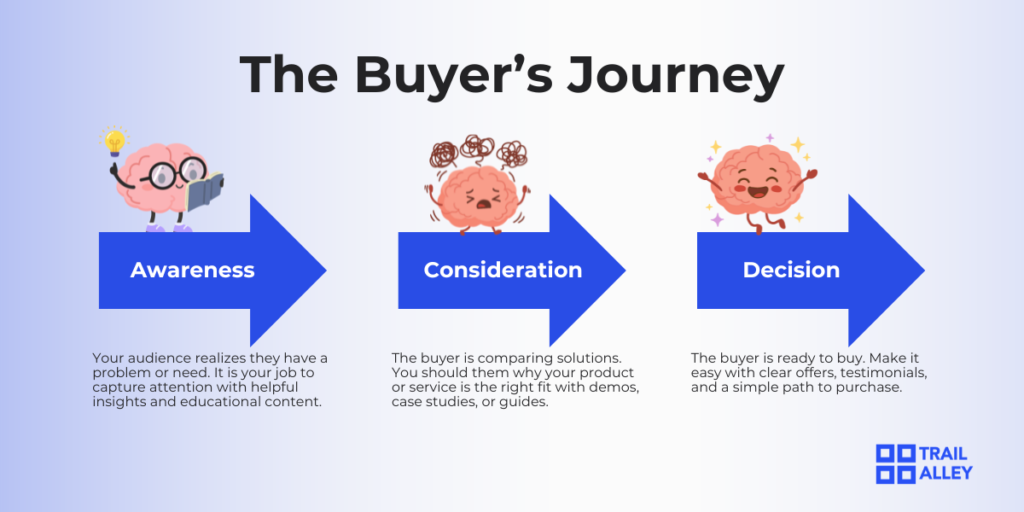
For example, someone who just discovered they have a payroll problem is at the awareness stage. They are not ready to buy yet, so they need information. They are searching for things like “how to manage payroll for a small business.” Content at this stage educates and builds trust.
Another person searching “best accounting software for small businesses in Nigeria” is at the decision stage. They are comparing options and closer to buying. Content here should show why your solution is the best choice.
As a content marketer, your job is to match your content to your audience’s stage. Bright explains:
“for the awareness stage, your audience probably does not know your solution yet. So you walk them through something useful and naturally plug in how your product helps. The decision stage is where you point out why your readers should choose you over competitors—your differentiators, your value, what makes you the better option.”
Understanding this distinction is what makes a content marketer truly valuable. Anyone can write, but not everyone can write the right thing for the right person at the right time.
This also applies to SEO writing. A strong content strategy decides what to write, who it’s for, and how it aligns with business goals. Without strategy, SEO content may rank but won’t convert. Without SEO, your strategy may go unnoticed. The content marketers who earn the most are the ones who combine strategic thinking with execution across all content marketing channels.
Is Content Marketing a Profitable Digital Marketing Skill?
Yes. But the writers who earn the most are the ones who understand what makes their rates go up.
i. Visible Results Trigger Rate Increases
Chidinma raised her rates (from ₦700 per article) when she could see her work attracting readers, and delivering value to clients. Seeing tangible results built her confidence to charge more. As a beginners, this means you must set clear KPIs and goals to track the impact of your work.
ii. Testimonials and Client Wins Justify the Next Price Jump
Every time Nathan received a meaningful client testimonial, he raised his rates. The accumulated proof of client satisfaction became his justification, so he didn’t have to wait for a performance review.
iii. Think Like a Strategist to Multiply Impact
When Bright was starting out, he charged $5–$10 per article. Later, as a one-person content team in his first SaaS role, he boosted the company’s monthly recurring revenue by over 20% in just 90 days through blog content alone. Bright links this growth to a mindset shift. He began thinking like a strategist. And this change meant he was no longer just writing, he was driving business impact.
iv. How Fast You Move Matters More Than How Long You Have Been Learning
Oluwaseun Akinlembola, a content writer for SaaS brands, believes “there’s no set timeline for how fast you can earn.” He cites content marketers like Jeremiah Ajayi, who reached $3,000 a month in under a year by stacking wins, moving jobs strategically, and leveraging results.
Across all four examples, it is clear that rates rise as the proof of work grows. So, while content marketing is a lucrative digital marketing skill, your earning growth is proportional to the quality and impact of your work.
How to Go From Beginner to Paid Content Marketer
Content marketing is one of the most accessible digital marketing skills to start with. Here is what your first steps should look like.
There is no shortage of free content marketing tutorials online. What is harder to find is a structured path that takes you from zero to job-ready, without guessing what to learn next. The Fundamentals of Content Marketing course covers everything you need: from understanding content goals, to writing SEO-friendly blog posts, designing visuals, distributing content on social media, and even finding your first clients. It also guides you through building a portfolio and managing client projects from start to finish, so you can confidently launch your content marketing career.
Getting clear on your niche and the value you bring can speed up your progress. Jescil Richard, who generated 2.1 million organic views for clients in 90 days, says her growth would have accelerated if she had defined earlier who she serves, what problem she solves, and what results she delivers. As she puts it, “clarity compounds faster than talent.”
Brands hire content marketers who can make people buy. And the key to doing that is understanding why people buy in the first place. Buyer psychology is the study of what makes people trust a brand, what language resonates with them, and what moves them from reading to acting.
Bright stresses that this type of insight is not one you can get from AI alone. You must deeply understand how content marketing works—the strategy behind it, the psychology driving it, and the craft holding it together—to consistently produce results. That is exactly why taking a structured course like the Fundamentals of Content Marketing is not optional. It is the foundation everything else is built on.
How to Build a Content Marketing Portfolio With Zero Paid Experience
The methods for building a content marketing portfolio are the same ones covered in the SEO section: start your own blog, create spec samples, guest posts, and personal projects. If you skipped that section, go back and read it. The advice applies here too.
But there’s one point we didn’t emphasise enough: distribution.
A portfolio piece that nobody sees does not build your reputation. Chidinma’s The State of Content Writing in Nigeria Report 2025 did not cross 10,000 LinkedIn views because it was well written. The result came because she shared her work in public.
The lesson is, distribution makes your work visible and bring opportunities. So, when you do good work, put it in front of people who need to see it.
Brands hire social media marketers because they want the right people to notice, trust, and eventually buy from them. Your job is to make that happen. That means studying the audience before creating content, tracking the right metrics to know whether the content is working, and knowing when to scale what is working with paid advertising.
However, most people jump straight into paid campaigns before they understand the audience they are spending money to reach. Chigozie Sussan, a social media marketer who grew a fashion brand from 15,000 to 70,000 Facebook followers before their launch day, says one non-negotiable across every campaign she runs is starting organically before spending a single naira on ads. In her words:
When you start with organic content, you understand what people are looking out for. You understand their desires, their wants, what they actually need. You need to know what they are sharing, what they are commenting on, what they are engaging with. So when you leave organic content and jump into paid advertising, you miss it.
That progression is the strategic thinking that makes a social media marketer valuable. It is also what separates the ones who deliver results from the ones who just keep posting and hoping.
What You Will Learn as a Social Media Marketer
When you start learning social media management, content creation is the first thing that makes sense. Strategy, audience research, client management, and portfolio building are the things that make you hireable.
Here is what the full learning path looks like:
i. Understand how Platforms Work Before you Post Anything
Before you manage any brand’s social media, you need to understand how each platform behaves, who uses it, and the kind of content that performs best there. This matters because what works on LinkedIn will rarely work the same way on Instagram. A TikTok video format may flop completely on Facebook.
That is why one of the first skills to learn is how to build a content calendar that matches the platform’s strengths instead of reposting the same idea everywhere. This Introduction to Social Media Management course walks you through these fundamentals from scratch. It covers how individual platforms work, how to set up accounts properly, and how to use Canva to start designing platform-specific content confidently.
ii. Build a Strategy Before you Create Anything
Imagine going to war without a strategy. It’s suicidal, right?
Similarly, posting without a strategy is like fighting blindly. A social media strategy tells you who you are talking to, what kind of content they respond to, and how to get more of the right people to engage with it. This means studying audience targeting, understanding engagement tactics, and knowing which content types and best practices apply to the brand you are working with. Strategy is what turns a social media manager from someone who posts into someone who grows.
iii. Prove You Can Grow an Audience Organically
The real test of a good social media marketer is how well you can you grow followers without relying on ads. And a badass content marketer will take it a notch further to convert those followers to paying customers.
Sussan proved this with a fashion brand launching a collection for married women who often felt unseen. Instead of posting generic product content, she built the campaign around the founder’s story and the emotional truth behind the collection.
Before launch day, people were already in the DMs asking to order. The collection sold out, and the account grew from 15,000 to 70,000 followers organically. This kind of result only happens when you understand your audience deeply enough to know what will move them.
The Introduction to Social Media Management course teaches you how to build and execute the strategies that make results like this possible.
iv. Learn the Business Side of Social Media Marketing
Knowing how to manage social media is one thing. Knowing how to build a career from it is another. This means learning how to approach businesses with cold outreach, manage clients professionally, set clear deliverables and timelines, and protect yourself with contracts and invoices. It also means building a portfolio that shows potential clients what you are capable of. The Trail Alley Social Media Management course covers all of this in its freelance business and portfolio building modules, walking you through everything from writing a contract to presenting your work in a way that wins clients.
Is 3-4 Months Enough to Become Job-Ready in Social Media Marketing?
The better question is not whether three to four months is enough, but what you choose to do with those three to four months.
Looking back, Sussan says that if she had to start social media marketing again in 2020, she would have started practising much earlier:
I would start practising immediately, even while still learning. Not the kind of internship where you just do basic copy and paste, but where you actually do the work. Do the research, analytical research, technical research, content analysis, set KPIs.
This distinction matters because reading about social media marketing and actually managing an account are two completely different experiences. The mistakes you make on a live account, the metrics you learn to interpret, and the client feedback you receive are things no course can fully replicate. They only come from execution.
At this stage, do not overthink the industry. Go anywhere that lets you manage a real account—fashion brands, startups, NGOs, beauty businesses, anything. What matters most is getting real exposure. The more industries you touch early, the faster you will see where your strengths are.
So, your first three to four months should focus less on chasing the title of “job-ready” and more on building proof that you have actually done the work.
How to Become an Impossible to Ignore Social Media Marketer
There is no shortage of people who call themselves social media marketers. What is rare is someone who can show a business exactly what their work produced. Jennifer Ejiegbu, a marketing strategist, draws the line clearly: “Certificates signify that you have learned something. Results are proof that you can execute.” The steps below are designed to help you do both.
i. Learn the Ropes From the Best
Before you update your bio to social media manager or marketer, you need a solid foundation. The Introduction to Social Media Management course on Trail Alley is where to start. It covers everything from platform setup and content strategy to audience targeting, client management, and portfolio building, giving you the structured knowledge base that free tutorials cannot.
ii. Understand the Brand’s Goals Before you Create Anything
Every brand you work with has a specific outcome they are trying to achieve: more sales, followers, leads, or awareness. Your job is to understand that goal before you write a single caption or design a single graphic. A social media marketer who starts with the brand’s goal in mind produces work that is easier to measure and harder to argue with.
iii. Track Results and Share Impact Reports
Every campaign you run should end with a report. Document what you set out to achieve, what the numbers showed, and what you would do differently next time. That habit does two things. It makes you a better marketer because you are constantly learning from your own data. And it makes you more hireable because every report becomes a portfolio piece that shows potential clients exactly what working with you looks like.
iv. Study Competitor Ads
Meta Ad Library is a free tool that shows you every ad currently running on Facebook and Instagram. Sussan recommends using it to analyze competitor campaigns and understand what is working in a specific market. But the research does not stop at paid ads. If you are working with a client in a specific industry, study what the top brands in that space are doing organically too—what they are posting, how their audience is responding, and what formats are getting the most engagement. Find five competitors, go through their content, and ask yourself: what is working here, why is it working, and could a similar approach work for this brand? That process of observing, analysing, and testing is what builds the strategic instinct that separates a good social media marketer from a great one.
5. Email Marketing & Automation
Every skill covered in this article so far helps businesses attract new customers. Email marketing on the other hand retains those customers and turns them into repeat buyers.
Jennifer who has managed over $300,000 in marketing budgets, is direct about where email sits in the earning hierarchy. In her words:
Some of the highest-paid specialisations within my network are paid media buyers(performance marketers), email and CRM marketers, and SEO strategists. These people are able to influence revenue, not just visibility.
This is what makes email marketing one of the most lucrative digital marketing skills for beginners to learn.
As an email marketer, your role goes beyond sending newsletters. Your core job is to use strategy, psychology, and automation to move people toward action. That action could be getting a reader to open the email, click a link, make a purchase, sign up for a product, or book a call.
What You Will Do End to End as an Email Marketer
Email marketing is beyond writing an email, sending it, and waiting for people to buy. The job is more layered than that. Here is what it actually looks like.
i. Understand the Business Goal Before You Write a Single Word
Before you open any email marketing tool like Mailchimp or type a subject line, you need to ask one question: what do we want people to do after reading this email?
That question determines your goal which might be to get a new subscriber to complete their first purchase. Or to bring back a customer who has not bought in three months. Or to move someone who downloaded a free guide closer to booking a call.
Each goal requires a different email, a different tone, and a different call to action. An email designed to re-engage a lapsed customer sounds nothing like one written to welcome a new subscriber. If you skip this step and go straight to writing, you will produce something that looks like an email but does not do a job.
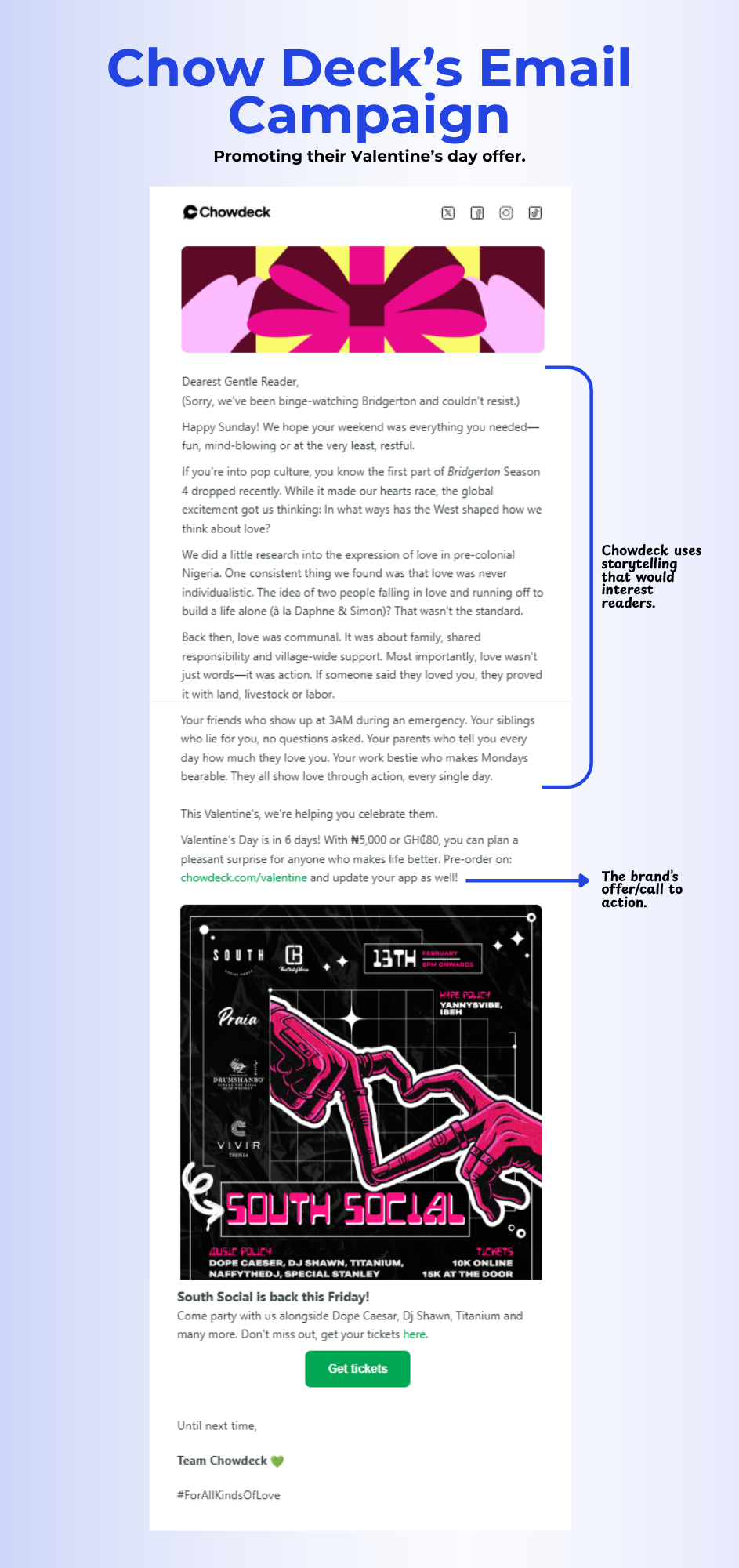
Simply put, every email should serve a business goal. Take this Chowdeck email as an example: what do you think its main purpose is?
ii. Build Email Sequences
A single email rarely moves someone to buy. What does the work is a sequence—a series of emails sent in a specific order, spaced out over days or weeks, each one designed to take the reader one step closer to the outcome the business wants.
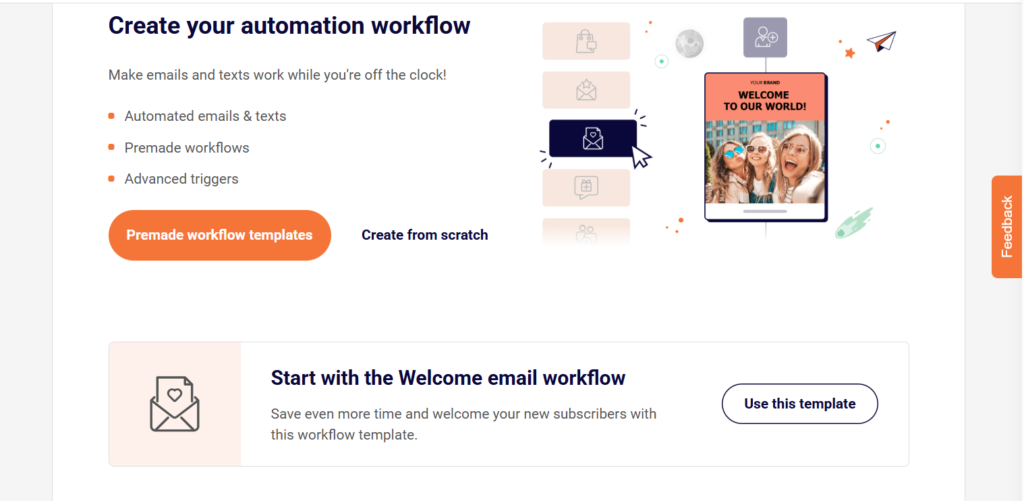
The most common sequence a beginner will be asked to build is a welcome sequence. When someone signs up for a newsletter or downloads a free resource, a welcome sequence introduces the brand, builds trust, and leads the new subscriber toward taking the next step.
A basic welcome sequence might look like this. Day 1 delivers what was promised and introduces the brand warmly. Day 3 shares a useful piece of content or the brand’s story to build credibility. Day 5 makes a soft pitch, showing how the product or service solves a specific problem. Day 7 follows up with social proof such as, customer stories, results, or testimonials. Each email connects to the next and moves the reader forward. That progression is the logic behind every sequence you will build.
iii. Segment the Audience
Not everyone on an email list wants the same thing. A first-time visitor who just signed up has different needs from a customer who has already bought twice. Sending both groups the same email ignores that difference, and the business loses money because of it.
Segmentation is how you fix that. It means dividing your email list into groups based on shared characteristics—how long someone has been subscribed, what they have clicked on, whether they have bought before, or what product they showed interest in. Each group then receives emails written specifically for where they are in their relationship with the brand.
As a beginner, you will not need to build complex segmentation systems from day one. But you need to understand the concept well enough to set it up inside whatever email marketing tool you are working with (Mailchimp, Sender, Klaviyo, or HubSpot).
iv. Set Up Behavioural Triggers and Automation
Most email tools allow you to set up automated emails that go out based on what a reader does or does not do. These are called triggers, and they are where the real earning power of email marketing lives.
If someone adds a product to their cart but does not complete the purchase, an automated email can go out an hour later reminding them it is still there. If a subscriber has not opened any email in 90 days, an automation can send a re-engagement email asking if they still want to hear from the brand. If someone clicks a link about a specific product, an automation can tag them as interested and follow up with more relevant content.
Gideon O., an email marketer who landed his first client through a cold email, explains why e-commerce brands in particular place so much value on this skill:
More money is made from automated flows than from regular campaigns in most cases. In fact, if a campaign does well, most e-commerce brands take it and include it in one or more of their flows.
The automation runs in the background, working around the clock without manual effort. Your job as an email marketer is to design those flows thoughtfully, test them regularly, and adjust based on what the data shows.
v. Track Performance and Optimise
Once your emails are live, your work is not done, yet. You’ll need to track some metrics which tells you what is working and what is not.
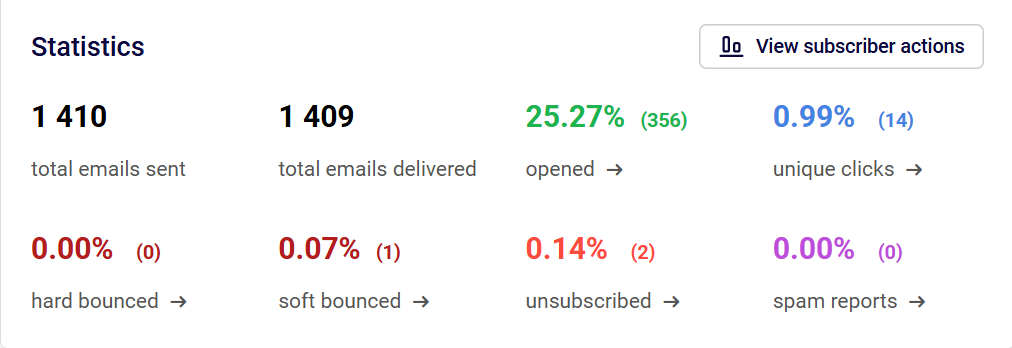
The three metrics every beginner needs to understand are open rate, click rate, and conversion rate. Open rate tells you how many people opened the email. Click rate tells you how many people clicked a link inside it. Conversion rate tells you how many of those people completed the action the email was designed to drive—a purchase, a sign-up, or a booking.
If your open rate is low, the subject line is likely the problem. If your click rate is low, the email body or the call to action is not compelling enough. If your conversion rate is low, the landing page the email leads to may need work. Each metric points to a different part of the process. Improving them is an ongoing cycle: write, send, measure, adjust, repeat.
Stacking Skills That Make You an Impossible-to-Ignore Email Marketer
The email marketers who earn the most are rarely just email people. Jennifer describes them as “marketers who can connect traffic to conversion, retention and revenue.”
What makes them valuable is their ability to connect email writing to the bigger business journey: how customers first discover a brand, what makes them buy, what keeps them coming back, and how all of that turns into revenue.
The easiest way to do that is by stacking complementary skills. Here are some recommended skills to stack:
i. Copywriting
A lot of beginners quickly learn how to use email marketing tools, but they aren’t enough to make campaigns convert.
When you combine email marketing with copywriting, you start to understand how to:
- Write subject lines people want to open
- Structure emails that hold attention
- Lead readers naturally toward a click, reply, or purchase
- Match the message to where the customer is in their buying journey
This depth of knowledge moves your work from sending emails to driving conversions.
For example, a welcome sequence for a skincare brand should not just introduce the business. It should reduce doubt, build trust, answer buying objections, and guide the subscriber toward a first purchase.
ii. Customer Psychology
Businesses want repeat buyers, renewals, upgrades, referrals, and long-term loyalty. To make that happen, you need to understand what keeps customers emotionally connected to a brand.
This is where customer psychology becomes a major advantage. Once you understand why people hesitate, what builds trust, what triggers urgency, why customers go cold after buying, and what makes them return, you can build automation that feel personal and timely.
This includes welcome flows, abandoned cart recovery, post-purchase nurturing, win-back campaigns, and even upsell and cross-sell sequences.
Jennifer calls this one of the most valuable combinations because you are no longer just “sending campaigns.” You are helping the business improve retention and repeat revenue.
iii. Analytics
Anyone can say they run email campaigns. However, when you can explain what happened after the email was sent, you become much harder to ignore.
Analytics helps you answer questions like:
- Which sequence drives the most purchases?
- At what email sequence do people stop clicking?
- Which segment converts best?
- What campaign increased repeat orders?
- What automation is underperforming?
This helps you to start speaking in outcomes. Instead of saying, “I manage email campaigns.”
You can confidently say, “I improved repeat purchases by 18% through post-purchase email automation.” The former tells clients what you do, while the latter tells them what result they get.
How you position your work determines your earning power. As Jennifer rightly puts it, brands pay for results tied to growth and revenue. So if you are learning email marketing as one of the most profitable digital marketing skills in Nigeria, do not stop at learning the tool. Learn the adjacent skills that help you influence the full customer journey.
How Long Does It Take to Become Job-Ready as an Email Marketer?
Honestly, it depends on what you are bringing into the skill. According to Gideon, two to four weeks of focused effort is enough to become job-ready in email marketing.
But that timeline is often realistic when you are transitioning from another digital marketing skill into email marketing, not necessarily starting from zero. For example, if you already have experience in SEO, content writing, copywriting, paid ads, or social media marketing, then you are not learning the hard part from scratch.
You already understand how to write clearly, how to guide people toward action, how to think about customer journeys, and how to align messaging with business goals. The transition can happen fast because what you are learning now is how those skills translate into email platforms, automation, and retention systems.
So instead of learning messaging from the beginning, you are mainly learning how these works: sequences, automation logic, segment audiences, trigger emails based on behaviour, and tracking performance in tools like Mailchimp, Klaviyo, or HubSpot.
In that context, two to four weeks is realistic.
But if you are starting from zero, give yourself two to three months of focused learning and practice. In those first few months, your goal is not mastery. It is to build a strong foundation.
This means understanding why welcome sequences matter, how abandoned cart flows recover lost revenue, what makes a post-purchase sequence improve retention, how segmentation changes the message people receive, and which metrics tell you whether the automation is working.
Gideon notes that becoming job ready is not just knowing where the call-to-action buttons are. This means that you must have an understanding of the why behind every action you take for a business.
You need to ask strategic questions like:
- Why should this trigger fire?
- Why does this segment need a different message?
- Why should this customer receive this email after purchase?
- Why is this sequence designed to improve retention instead of first-time conversion?
That strategic thinking is what makes a business trust your work. And even after you become job-ready, the learning never really ends.
As you start working on real campaigns, you begin to learn the deeper layers:
- Lifecycle marketing
- Advanced segmentation
- Deliverability
- A/B testing
- Retention strategy
- CRM workflows
- Revenue forecasting
So yes, there are realistic timelines: 2–4 weeks if you are transitioning from another digital marketing skill; 2–3 months if you are starting from zero.
But in both cases, what really accelerates your growth is moving quickly from foundational knowledge into building real automation. However, you must take things slow, one step at a time.
How to Build Your First Email Marketing Portfolio
Businesses want proof that you can write emails people engage with, build automations that support the customer journey, and most importantly, connect your work to revenue.
The good thing is that you do not need a paying client before you start building that proof.
i. Become an Intern Email Marketer
Find brands you can intern with, volunteer for, or support at a beginner level.
This could be a creator building a newsletter, a fashion or skincare business, an ecommerce store, a startup SaaS, or even a coach selling digital products. The goal is to get access to a real audience and real data.
ii. Create High-value Automation
Once you begin working with a real brand, focus on writing high-value automation that naturally belong in a beginner portfolio. A simple 5-email welcome sequence is one of the best places to start.
This might include emails like, welcome and brand introduction, product or offer education, trust-building and testimonials, objection handling, first purchase incentive, and follow-up reminders.
From there, you can expand into abandoned cart recovery, post-purchase sequences, newsletter campaigns, and win-back flows for inactive subscribers. These are the kinds of projects that help a business make money, which makes them great portfolio assets.
iii. Document the Metrics That Matter
For every project, document the results. Track the open rates, click-through rates, replies, purchases, lead signups, repeat orders, and conversion rates.
Even if the project is small, the numbers make your value easy for future clients to understand. And that is what helps you move from small gigs to higher-paying retainers.
As a beginner your portfolio should communicate that you understand the why behind the automation, I can build it, and I can show what happened after it went live.
How to Choose the Right Digital Marketing Skill to Start With
“So what skill can I learn to make money?” I know that’s probably the question on your mind after reading through all five digital marketing skill.
The honest answer is that any of the five skills in this article can generate income. The question is which one is the right starting point for you specifically.
There are three ways to think about that decision.
i. Match the Skill to Your Natural Strengths
If you are analytical and enjoy working with numbers and data, PPC is your best starting point. If you love writing and researching, content marketing or SEO will come more naturally. If you are socially aware, understand trends, and know how to read a room, social media marketing is where you will thrive. And if you are persuasive with words and can get people to take action, email marketing is where your instincts will serve you best.
ii. Match the Skill to Your Income Goals
Not every skill produces income at the same speed. If your priority is fast freelance income, focus on skills with faster feedback loops and easier proof of work. Digital marketing skills like: Meta ads, email marketing, content writing, and social media management are easier to monetise because brands can see results faster.
But if your goal is a long-term career with compounding earning power, then SEO and PPC are stronger bets. They take longer to mature, but the long-term upside is huge because both skills sit close to traffic, conversion, and revenue.
iii. Use the Skill-Stacking Principle
One of the biggest mistakes beginners make is trying to learn everything at once. SEO today, PPC tomorrow, email next week, and social media the week after. That scattered approach slows growth because you never learn one digital marketing skill long enough to build real competence.
But this does not mean your first year should be narrow. Jennifer advises that: “At the beginning, don’t be in a hurry to niche down. Explore first, then focus. In your first year, try different areas and build basic competence. Then pick one or two areas you have flair for, see major results in, or areas where you see demand.”
The keyword in Jennifer’s advice is to explore. It means giving yourself enough exposure to understand how different digital marketing skills connect. For example, you might start as a content writer but get exposed to keyword research, SEO briefs, or newsletter writing. And that exposure helps you understand where your strengths naturally produce the best results.
But even while exploring any digital marketing skill, you still need to commit to learning one deeply enough to become useful, confident, and paid. Everything else gives you career context and future stacking options. Chidinma was once a generalist marketer, and she says: “Niching down gave me focus and helped me develop depth in my field. Over time, it also helped me increase my rates. But beginners who are struggling to niche down shouldn’t rush the process. In the early stages, exploring different industries helps. It shows what feels interesting, what feels draining, and what doesn’t fit at all.”
The goal is not to learn five things at once. It is to go deep on one skill while staying curious about the ones around it, and that is what makes skill stacking powerful.
Mistakes Most Beginners Make (And How to Avoid Them)
A lot of beginners still struggle to make money because of the mistakes they make after learning a digital marketing skill.
Here are the five most common ones to watch out for.
i. Waiting to Feel Ready Before Pitching Clients
A lot of beginners wait too long. They tell themselves: “Let me finish one more course.” Or, “Let me improve my portfolio first.”
But the feeling of readiness rarely comes from more preparation. It comes from doing the thing you are avoiding. Jescil believes that “execution compresses doubt.” The clients you want are not waiting for you to feel confident. Start pitching with what you have right now.
ii. Thinking in Naira When Pricing for Foreign Clients
When you price your services in naira equivalents for foreign clients, you are leaving significant money on the table. Nathan warns against it: “Thinking in naira when working with foreign clients isn’t going to scale.” Foreign clients are paying in dollars, pounds, and euros. Your rates should reflect the value you are delivering in their market, not what feels comfortable in yours.
iii. Not Building in Public From Day One
Most beginners wait until they feel established before they start posting on LinkedIn. That is the wrong order. Oluwaseun wishes he had understood this earlier: “I felt like I didn’t need to build a personal brand. I wish I took LinkedIn seriously from the start. Build in public, on LinkedIn. Make enough noise about what you’re learning and doing. The visibility and network will be the foundation for client acquisition, retention, and the business as a whole.” In other words, if you’re considering learning any digital marketing skill, you have to be visible where your prospects are.
iv. Over-relying on AI Without Learning the Fundamentals
AI can produce content fast, but the depth of your knowledge as a digital marketer determines whether that content is subpar or superb. Bright is clear about the danger of skipping the fundamentals of any digital marketing skill: “In this AI age, we should always strive to learn the fundamentals of writing and buyer psychology. The nuance that makes content interesting, fun, and polished—AI cannot replicate that.” The point is that you need to use AI as a tool. Rather than using it as a substitute for understanding your craft.
v. Not Extracting Proof From Every Project
Every campaign you run, every client you serve, and every result you produce is an asset, only if you document it. Jescil learned this the hard way: “When I helped grow authority or supported clients, I didn’t always turn those into visible assets. Testimonials, case studies, measurable before-and-afters, and it slowed down my perceived authority. Now I make sure to get testimonials and create case studies. Because at the end of the day, proof works over talk.” From your very first project, make it a habit to collect testimonials, document results, and turn every win into a portfolio piece.
Pick One Digital Marketing Skill
The five skills covered in this article—PPC, SEO, content marketing, social media marketing, and email marketing—are among the most profitable skills to learn in Nigeria right now. Each one has a clear entry point, a realistic earning trajectory, and a growing demand from businesses that need people who can deliver results.
If you want a structured, beginner-friendly path to learn digital marketing skills like content marketing, social media management, or any of the other skills covered in this article, Trail Alley’s courses will guide you through this stage.
Instead of piecing together random YouTube videos, you get:
- A clear roadmap from zero to job-ready
- Practical projects to build your portfolio
- The exact fundamentals most beginners skip
- Guidance on how to position and monetise your skill
- Support that helps you move faster with confidence
Our goal at Trail Alley is to help you turn one digital marketing skill into proof, income, and long-term career leverage.
So, which of these lucrative digital marketing skills will you commit to learning deeply over the next few months?
Share this Article
